MLB · Mets analysis
The Mets can keep Semien. They still need a second-base contingency.
November 13, 2026
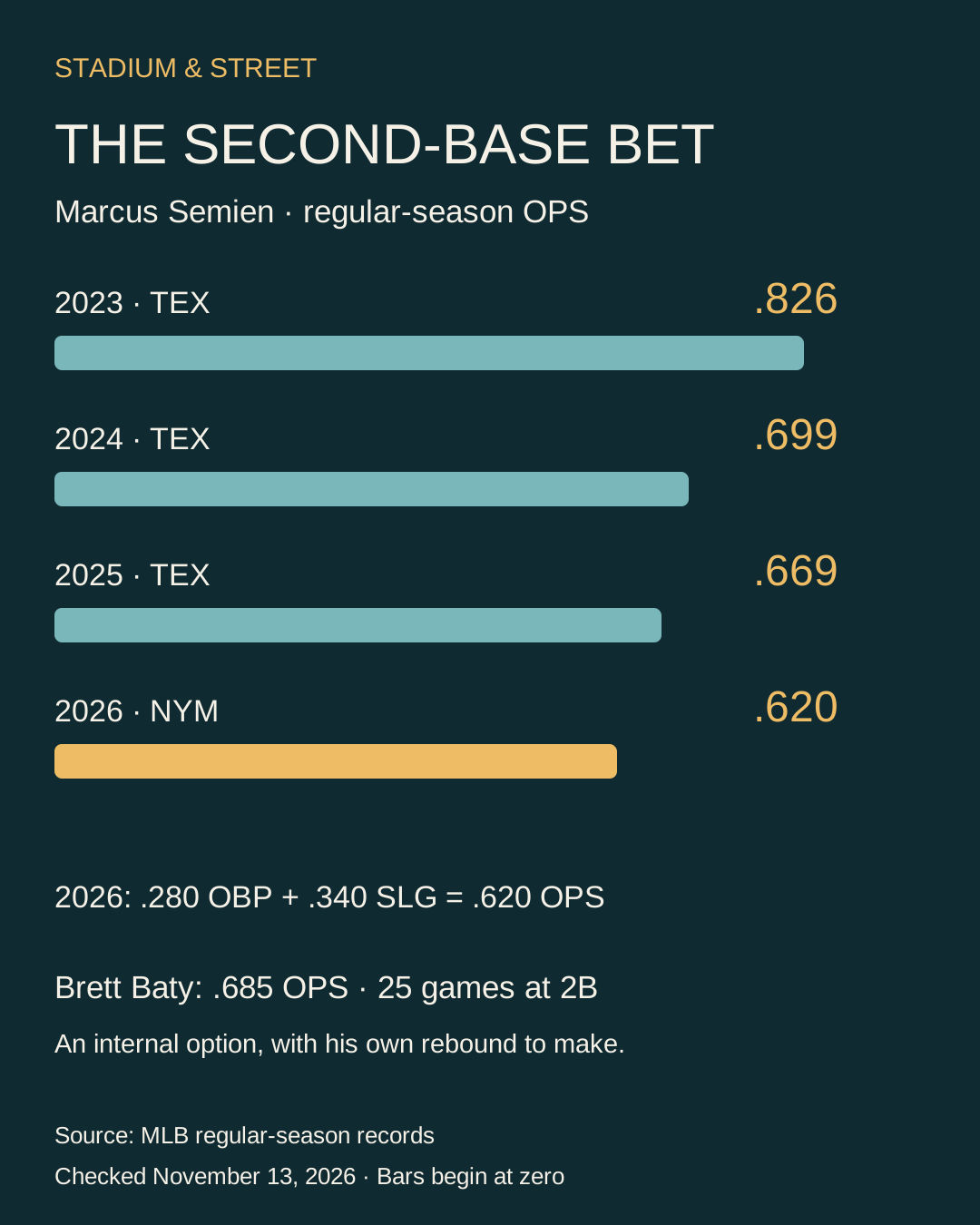
David Stearns told MLB.com the Mets are not currently seeking a second baseman. The case for patience needs a measurable limit: how much improvement would make Marcus Semien an asset in the lineup, and what happens if it does not arrive?
Semien’s OPS has fallen from .826 in 2023 to .699 in 2024, .669 in 2025 and .620 in 2026. The first three seasons were with Texas; the latest was with the Mets. His 2026 line was .215/.280/.340 across 547 plate appearances. A player can recover from a poor season, but this is a three-year downward sequence, not one isolated dip.
The latest decline came on both sides of OPS. His on-base percentage fell 25 points from 2025 and his slugging percentage fell 24. The home-run total stayed at 15, despite 13 more plate appearances. Restoring some power would help; reaching base more often is part of the same assignment.
The internal alternative needs scrutiny too
Brett Baty is an available internal alternative. The current Mets roster lists both players, along with Bo Bichette. Baty played 25 games at second base in 2026, including 23 starts and 184 innings. That is actual major-league experience at the position, though a limited foundation for projecting a full season there.
Baty’s .685 OPS was 65 points higher than Semien’s in 2026. It was also down from his own .748 in 2025. He finished at .238/.311/.374 with 11 home runs in 473 plate appearances. Giving him more responsibility could improve the position, but the comparison should not turn his season into a breakout it was not.
Baty made no errors in 81 chances at second. That establishes what happened on those recorded chances. It does not measure all the ground he covered, the balls he could not reach or the cost of asking him to move among positions. A longer defensive assignment would supply better evidence.
A plan with a decision point
MLB.com reports $46 million remains through 2028. That commitment gives the Mets a reason to work on Semien’s production; it should not decide every future plate appearance. The money is already committed. The remaining choice is how to use playing time to get the strongest lineup.
The sensible internal route is to enter spring training with both players prepared for second base and judge the quality of their contact, plate decisions and defense alongside results. A few exhibition hits would be weak evidence against several seasons of decline. A durable improvement in those underlying tasks would be more persuasive.
The Mets do not need to buy a replacement merely to demonstrate activity. They do need an alternative that is ready to play. Keeping Semien and protecting his job are different decisions. His recent record makes that distinction central to the winter.
Go to the sources
See something that needs attention? Read our corrections process.